The Ultimate Solitaire Mastery Guide: Winning Strategies for Klondike, FreeCell & Spider
Klondike, FreeCell, and Spider look similar across a digital screen. They share green felt backgrounds and card suits. The resemblance ends there. Each variant operates on entirely distinct mathematical foundations, information states, and combinatorial constraints.
Playing Klondike like FreeCell leads to rapid failure. Treating Spider like Klondike creates deadlocked card columns within ten turns. Moving past casual card stacking requires mastering the specific tactical rules, empty space mechanics, and card counting principles that govern each discipline.
The Mechanics and Solvability Realities
Solitaire is not a single game. It is a family of sorting problems with radically different solvability profiles.
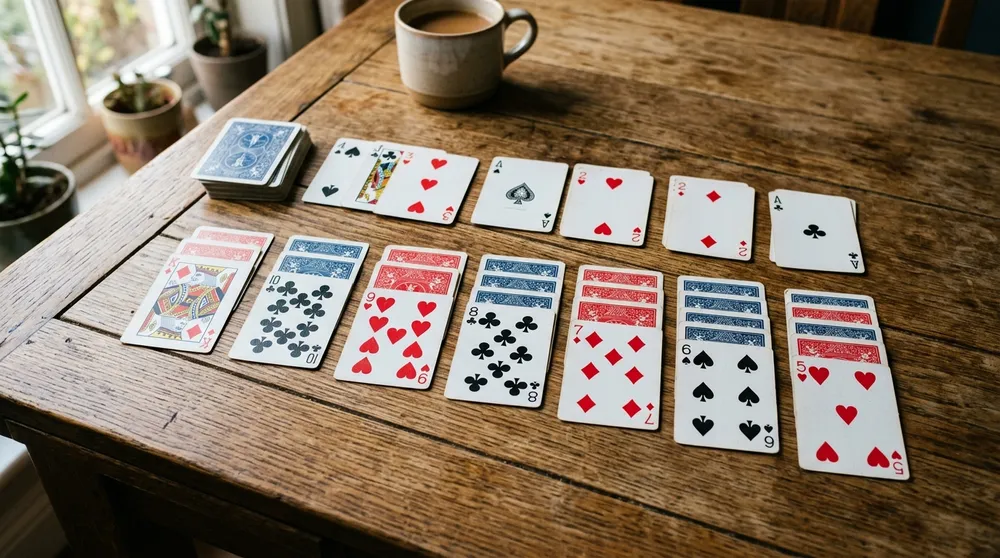
Klondike is an imperfect information game. Out of 52 cards, 21 start face down in the tableau and 24 reside in the stockpile. Only 7 cards begin visible. Mathematicians analyzing Klondike have calculated that roughly 79 to 82 percent of all possible deals are theoretically solvable under conditions of complete omniscience. But human players do not have X-ray vision. When playing Turn-3 Klondike without knowing what lies under the face-down cards, skilled human win rates hover between 30 and 43 percent. Turn-1 Klondike yields significantly higher success rates around 80 percent because every pass through the waste deck reveals new individual options.
FreeCell eliminates hidden information entirely. All 52 cards are dealt face up across eight cascade columns. Because every single card rank and suit is known from the opening millisecond, FreeCell is a deterministic puzzle. Out of the original 32,000 Microsoft FreeCell game deals, only one single deal (number 11,982) is truly impossible to solve. Across all random deals, mathematicians have proven that over 99.99 percent of FreeCell configurations can be won with precise sequencing. Every loss in FreeCell stems from human miscalculation, not bad luck.
Spider Solitaire introduces brute combinatorial scale. Played with two complete decks totaling 104 cards, Spider distributes 54 cards across ten tableau columns, leaving 50 cards in five reserve sets of 10. While One-Suit Spider is forgiving with win rates above 90 percent, Four-Suit Spider is brutal. Top tournament players rarely exceed a 30 to 35 percent win rate in Four-Suit Spider. The reason is mechanical: you can build descending sequences regardless of suit, but you can only pick up and transfer groups of cards if they belong to the exact same suit. Mixing suits creates tangled, immovable blocks that choke board mobility.
Klondike Solitaire: Foundation Discipline and Hidden Card Priority
The central error in Klondike is racing cards into the four foundation piles too quickly.
Beginners see an Ace or Two and slam it onto the foundation immediately. Then they see a Three and send it up. Two turns later, they need that black Three to catch a red Two from a deep column, but the Three is trapped in the foundation. The game stalls.

The Rule of Foundation Equilibrium
Never promote a card to the foundation unless its opposite-color protectors are already secured. You can safely send Aces and Twos to foundations instantly. They hold zero utility in the tableau because no card can build on top of an Ace in the columns.
For Threes and higher, apply the Rule of Foundation Equilibrium: do not promote a card of rank N until both cards of rank N-1 in the opposing color are already visible in the tableau or foundations.
For instance, hold back the 4 of spades until both the 3 of hearts and the 3 of diamonds have appeared. If you send the 4 of spades to the foundation while a red 3 remains buried under five face-down cards, you permanently destroy your ability to anchor that red 3 when it surfaces. The foundation is a one-way street in standard tournament scoring. Treat it with restraint.
Face-Down Column Priority
Always play from the tableau before turning a card from the stockpile. Every hidden card in the tableau represents dead capital.
When choosing between moving a card from the waste pile or moving a card within the tableau, examine the face-down cards. If moving a 7 of hearts in the tableau exposes a face-down card in column seven, that move takes absolute priority over playing a 7 of diamonds from the waste. Column seven has six face-down cards. Unlocking column seven reduces hidden entropy and gives you six opportunities to find key connectors. Clearing column one or two only exposes one or two hidden cards.
Rank your tableau moves by column depth:
1. Moves that reveal face-down cards in the deepest columns (columns 5, 6, and 7).
2. Moves that reveal face-down cards in shallow columns (columns 2, 3, and 4).
3. Moves from the waste pile that directly enable a deep column revelation.
4. Moves to empty a column when a King is already available to fill it.
Never empty a column simply because you can. An empty column without a King waiting in hand is a liability. It reduces your active tableau space from seven working columns down to six. Keep cards where they are until a King of the appropriate suit and sequence is ready to drop into the vacant slot.

Turn-3 Stockpile Tracking
In Turn-3 Klondike, cards pass through the waste pile in triplets. Every time you pull a card from the waste, the alignment of all subsequent triplets shifts.
Track the cards you bypass. If the waste shows a King, an 8, and a 5, and you play the 5, the card immediately behind it becomes accessible. More importantly, on your next pass through the deck, the entire cadence of triplets will be offset by one. Dedicated players memorize the location of critical blocker cards during the first pass without playing them. By timing when you extract a card on the second pass, you can pull forward buried cards that were unreachable on pass one.
FreeCell: The Geometry of Empty Space and Supermoves
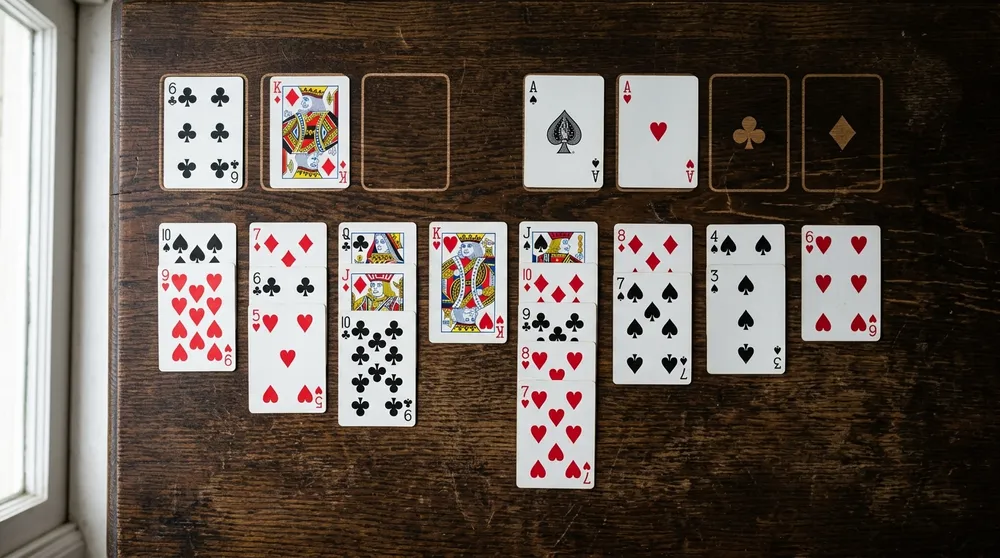
FreeCell is a game of space management. You have four free cells in the top left, four foundation piles in the top right, and eight cascade columns below.
The biggest misconception in FreeCell is treating the four free cells as permanent holding pens. They are not storage lockers. They are high-speed transit buffers. The moment you fill all four free cells with random cards, your game is dead.
The Supermove Formula
In physical FreeCell, you can only move one card at a time into a free cell, transfer a single card to a tableau column, and then move the card back. Digital FreeCell automates this sequence, letting you move an entire packed sequence in one click. But the software strictly respects physical mechanics.
The maximum number of cards you can move simultaneously as a valid sequence is governed by a precise mathematical formula:
Max Cards = (1 + F) * 2^E
Where:
Examine the power of empty tableau columns in this equation. If you have four empty free cells and zero empty columns, you can move:
(1 + 4) * 2^0 = 5 * 1 = 5 cards
If you have two empty free cells and one empty tableau column, you can move:
(1 + 2) * 2^1 = 3 * 2 = 6 cards
If you have three empty free cells and two empty tableau columns, your capacity explodes:
(1 + 3) * 2^2 = 4 * 4 = 16 cards
An empty tableau column is exponentially more valuable than an empty free cell. While an empty free cell adds plus-one to your base capacity, an empty column doubles your total capacity. Sacrificing two free cells to clear out a single tableau column is almost always a winning trade.
Backwards Dependency Resolution
Before making your first move in FreeCell, scan the bottom-most cards of all eight cascades. Identify the Aces and Twos.
If the Ace of spades is buried at the top of column four beneath five heavy cards, your entire opening phase must focus on dismantling column four. Do not scatter cards across free cells aimlessly. Work backward:
1. Identify the card directly blocking the Ace.
2. Find an eligible home in another column for that blocker.
3. If no column exists, allocate a single free cell for it.
4. Unpack the column systematically until the Ace releases directly to the foundation.
Keep at least two free cells open at all times. Two open cells give you the tactical flexibility to swap cards and juggle sequences. If you drop to one open cell, you enter the danger zone. If you drop to zero open cells, you lose the ability to perform multi-card transfers.
Spider Solitaire: The Column Emptiness Engine
Spider Solitaire is a relentless test of organizational stamina. In Two-Suit and Four-Suit Spider, random card movement guarantees defeat. The board becomes cluttered with mixed-suit junk, locking down your columns before the second round of stock cards is even dealt.
In-Suit vs Off-Suit Builds
In Spider, you can place a 6 of clubs onto a 7 of hearts. The game allows it. But that move carries a massive hidden penalty: you can no longer move that 7 and 6 together.
The 6 of clubs is now dead weight sitting on top of the 7. To move the 7 in the future, you must first find a home for the 6 of clubs, peel it off, and place it elsewhere. If you build five off-suit cards in a row, you create an immovable column that paralyzes your game.
Prioritize in-suit builds above all else. When an off-suit move is mandatory to expose a hidden card beneath, make the move with a clear escape plan. Ask yourself: where will this off-suit card go when I need to unpack the stack? If you do not have an empty column or an alternate card ready to absorb it, pause and seek another path.
The Pure Run Imperative
A complete sequence in Spider runs from King down to Ace in the exact same suit (13 cards). Once completed, the entire sequence vanishes from the board and locks into the foundation.
Every completed run removes 13 cards of board friction. In Four-Suit Spider, you cannot assemble 13-card runs by accident. You must dedicate specific columns to pure suits:
1. Designate primary builder columns. Keep them strictly single-suit (e.g. spades only).
2. Designate secondary junk columns. Use these columns to temporarily absorb mismatched off-suit cards.
3. Once an empty column opens, use it as a sorting funnel. Transfer the off-suit junk from your primary builder into the empty space, reuniting split in-suit sequences.
Never spread off-suit cards evenly across all ten columns. That mistake pollutes the entire board. Concentrate your clutter into one or two sacrificial columns so the remaining eight columns retain clean, movable in-suit sequences.
Preparing for the Stock Deal
Spider has five stock deals of 10 cards each. Every deal drops one card onto every single column.
Before dealing a new layer from the stock, execute every possible useful reorganization. Never deal onto an empty column; the game will not allow it anyway. Fill empty columns with temporary cards before dealing, but ensure those temporary cards can be cleared quickly afterward.
Most critically, make sure your high-value sequences are not left exposed right before a deal. If you have an eight-card pure spade run ending in a 4 of spades, dealing from the stock will land a random card right on top of that 4. If that random card is an off-suit Queen, your eight-card spade run is instantly buried under an off-suit blocker. Where possible, cap your active sequences with cards that are easy to clear or build onto.
Strategic Comparison Matrix
Understanding how tactical priorities shift between games prevents strategic confusion:
| Strategic Dimension | Klondike Solitaire | FreeCell | Spider Solitaire (4-Suit) |
| :--- | :--- | :--- | :--- |
| Information State | Imperfect (21 hidden tableau cards) | Perfect (100% visible from turn 1) | Mixed (54 cards visible, 50 in stock) |
| Primary Bottleneck | Revealing deep face-down cards | Managing free cell capacity | Untangling off-suit cross-stacking |
| Foundation Policy | Restrained (wait for opposite colors) | Aggressive for Aces/Twos, balanced for 3+ | Complete 13-card runs only (automatic) |
| Empty Column Value | High (must fill with Kings) | Extreme (doubles supermove power) | Critical (vital sorting funnel for suits) |
| Reversibility | Partially reversible (deck recycles) | 100% reversible (full deterministic path) | Irreversible once stock deals are triggered |
| Average Human Win Rate | 30% to 43% (Turn-3) | 85% to 95% (skilled play) | 25% to 35% (top-tier play) |
The Step-by-Step Solitaire Recovery Checklist
When a game appears deadlocked, do not hit restart immediately. Work through this systematic diagnosis:
1. Scan for foundation retractions: In Klondike and FreeCell, check if pulling a card back down from the foundation onto the tableau creates an open step for an otherwise stuck card.
2. Count empty cells and compute transfer capacity: In FreeCell, calculate your exact supermove limit using the formula (1 + F) * 2^E. You may find that shifting two cards opens a cascade column that unlocks a four-card move.
3. Trace dependency trees backward: Locate the single card blocking progress. Trace which card blocks it, which card blocks that one, and whether an empty slot can act as a circuit breaker.
4. Shift packed piles into open columns: In Spider, strip away off-suit tail cards to test whether the remaining upper run is pure and movable.
5. In Klondike, calculate remaining passes: If playing Turn-3, calculate whether taking one specific card from the waste flips the polarity of the remaining passes through the deck.
Patience separates casual players from masters. By respecting the underlying mathematics of each variant, managing empty spaces as your primary currency, and maintaining strict foundation discipline, your win rates across Klondike, FreeCell, and Spider will climb consistently.
Download Free Klondike Solitaire Rules & Strategy Cheat Sheet (PDF)
Save a copy to your computer or print for your classroom or game club.

Gopal Chitaure
Verified Author & Game DeveloperGame developer and founder at Unicorn Games. Specializes in combinatorial game theory, solvability algorithms, and classic card & puzzle game development. Every guide is fact-checked against mathematical game states and empirical play benchmarks.