How to Win at Gin Rummy: Knocking Thresholds, Undercut Math, and Discard Traps
Most card games reward passive patience. Gin Rummy punishes it. Every turn you delay, your opponent extracts cards from the stock, tightens their melds, and prepares to end the round before you lay down a single set.
Gin Rummy is a two-player zero-sum contest of incomplete information. Luck dictates the opening deal of ten cards. Skill dictates everything that follows. Master players do not wait for miraculous draws. They force advantageous discards, calculate deadwood point differentials on every pick, and knock the exact moment mathematical expectation swings in their favor.
You can test these principles immediately without download by playing Gin Rummy on Unicorn Games directly in your browser.
The Mathematical Origin and Core Rules of Gin Rummy
Elwood T. Baker and his son C. Graham Baker invented Gin Rummy in 1909 at the Knickerbocker Whist Club in New York City. They wanted a variant of standard Rummy that played faster, penalized loose play harder, and rewarded tactical declarations. They named the game after gin and rum liquor.
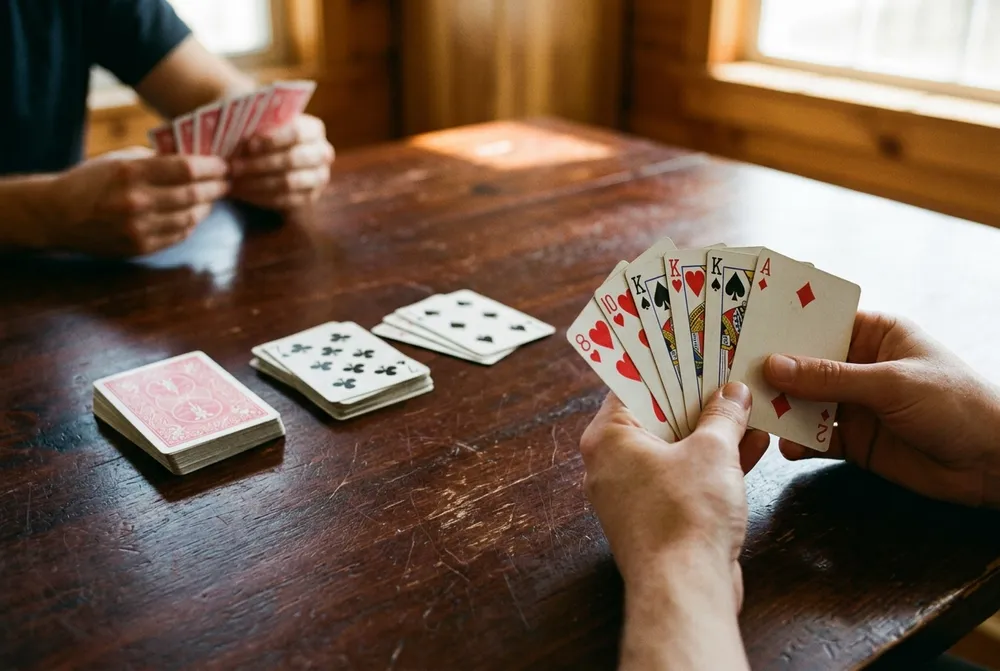
A standard 52-card deck is used. Ten cards are dealt to each player. The twenty-first card is turned face up to begin the discard pile, while the remaining thirty-one cards form the facedown stockpile.
Cards fall into two categories: melds and deadwood.
Melds consist of two distinct card formations:
1. Sets: Three or four cards of identical rank across different suits (such as 8 of Spades, 8 of Hearts, 8 of Diamonds).
2. Runs: Three or more consecutive cards of the exact same suit (such as 4 of Clubs, 5 of Clubs, 6 of Clubs).
Aces are strictly low. An Ace counts as 1 point. Sequences like Ace-2-3 of hearts are legal runs. Sequences like King-Ace-2 are strictly illegal.
Deadwood represents all unmatched cards left over in your hand after extracting your melds. Deadwood cards carry fixed point penalties:
| Card Rank | Deadwood Point Value | Strategic Liability Rating |
|---|---|---|
| King, Queen, Jack, 10 | 10 points each | Extreme early liability |
| 9, 8, 7 | 9, 8, 7 points each | Moderate liability |
| 6, 5, 4, 3, 2 | 6, 5, 4, 3, 2 points each | Low liability |
| Ace | 1 point | Negligible liability |
The objective of every hand is simple: reduce your deadwood count to ten points or fewer to knock, or eliminate deadwood entirely to score Gin.
The First Upcard Dilemma: Why Pickups Leak Lethal Information
The opening turn creates the first strategic fork in the road. The non-dealer gets the first right of refusal on the twenty-first card turned face up.
Amateur players take the upcard whenever it matches a single card in their hand. If they hold the 9 of Diamonds and see the 9 of Spades on the discard pile, they take it immediately.
This is a fundamental error. Taking an upcard on turn one provides your opponent with verified intelligence.
Your opponent now knows two critical facts:
1. You hold at least two Nines.
2. The remaining Nines in the deck are dangerous to discard.
Your opponent will hold their Nines. You freeze their hand while revealing your own plan.
Draw from the closed stockpile on turn one unless the face-up card performs one of three actions:
1. Completes a three-card meld immediately.
2. Forms an open-ended suited run (such as holding 7 of Hearts and 8 of Hearts, then picking up the 6 or 9 of Hearts).
3. Replaces a 10-point deadwood card with an Ace or Two, drastically reducing your total count.
Taking an upcard to create a speculative two-card holding gives away board control for almost zero mathematical gain. When in doubt, pass the upcard and force the dealer to choose.
Combinatorics of Meld Building: Sets vs. Runs
Every turn requires deciding which partial combinations to keep and which to cut. Understanding combination math determines which card pairs deserve space in your hand.

Compare a pair of Kings against an open-ended suited pair like the 8 and 9 of Spades.
A pair of Kings has exactly two cards remaining in the deck that can complete the set (the King of Hearts and King of Diamonds, assuming you hold Clubs and Spades). If your opponent holds one King, you are drawing to a single out. Your probability of hitting that card from the unknown deck is tiny.
An open-ended suited connector has four distinct outs. Holding the 8 of Spades and 9 of Spades, you can complete the run with:
1. The 7 of Spades.
2. The 10 of Spades.
3. Another 8 (switching to a set).
4. Another 9 (switching to a set).
The suited connector provides double the completion paths of a raw pair.
runs can expand on both flanks. A completed run of 7-8-9 of Spades can absorb the 6 of Spades or the 10 of Spades on subsequent turns. A four-card set is a dead end. Once you hold four Sevens, that meld cannot grow. It cannot absorb extra cards.
Prioritize open-ended suited sequences over isolated high pairs during the first three turns of play.
Triangle Formations: The Secret of Dual-Threat Holdings
Top-tier Gin Rummy players build triangle structures in their opening hands.
A triangle consists of three cards that share two distinct meld possibilities. For example, hold:
This three-card structure attacks the deck from two directions:
1. It needs an 8 of Clubs or 8 of Diamonds to complete an 8-8-8 set.
2. It needs a 7 of Spades or 10 of Spades to complete a 7-8-9 spade run.
Instead of dedicating four cards to two unrelated pairs, you dedicate three cards to four potential outs. This conserves hand space, leaving you extra slots to hold defensive discards or low deadwood exit cards.
When you draw a card that completes one branch of the triangle, the leftover card is discarded or paired with another incoming piece.
The Knocking Threshold: Turn-by-Turn Mathematical Expectation
Standard rules permit knocking when your unmatched deadwood totals ten points or fewer. The ability to knock does not mean you should knock immediately.
Your decision to knock depends entirely on turn count and deadwood quality.
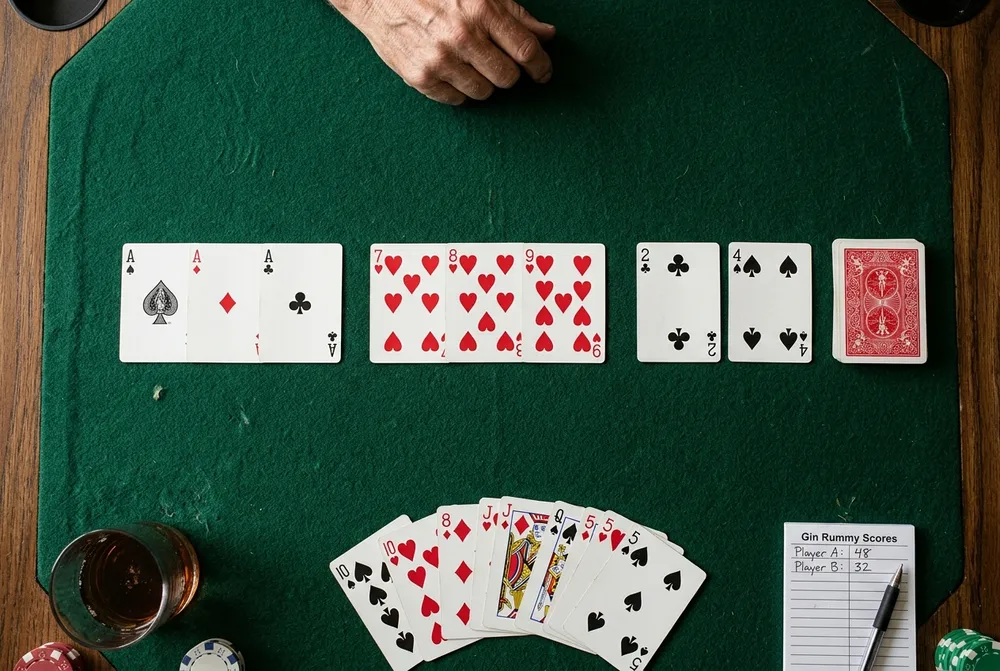
Knocking early (turns 1 through 5):
Knock immediately if your deadwood is 10 points or below. On turn four, your opponent has only drawn four cards. The statistical probability that they have formed two complete melds and reduced their deadwood below ten is under twelve percent. Even with 9 or 10 points of deadwood, an early knock catches the opponent loaded with unorganized high cards. You win the point differential cleanly.
Knocking mid-game (turns 6 through 9):
The danger zone begins here. Your opponent has drawn six to nine cards. They have likely organized at least one major meld and discarded their obvious high-value liabilities. Knocking with 8, 9, or 10 points of deadwood during mid-game invites an undercut. Knock only if your deadwood is 5 points or lower.
Knocking late-game (turns 10 and beyond):
Never knock with more than 2 or 3 deadwood points late in the hand. By turn ten, the opponent is almost certainly holding seven to nine melded cards. Knocking with 7 points of deadwood will result in an undercut disaster. If you cannot reach 3 points or fewer, keep drawing and push for complete Gin.
| Game Phase | Turn Range | Maximum Recommended Knocking Deadwood | Risk of Undercut |
|---|---|---|---|
| Early Game | Turns 1 - 5 | 10 points | Minimal (under 12%) |
| Mid Game | Turns 6 - 9 | 5 points | Moderate (25% - 40%) |
| Late Game | Turns 10+ | 2 points (or wait for Gin) | Severe (over 60% if deadwood > 5) |
The Undercut Penalty: Mechanics of Catastrophic Losses
An undercut occurs when a player knocks, and the defending opponent reveals an equal or lower deadwood count.
When you knock, you lay down your melds and set your deadwood aside. The defender does the same. Crucially, the defender receives a massive tactical privilege: layoff rights.
The defender can lay off their unmatched deadwood cards onto your melds.
Suppose you knock with 6 points of deadwood:
Your opponent holds:
Under normal counting, you would win by 11 points. But your opponent uses layoff rights. They attach their 7 of Hearts onto your 4-5-6 of Hearts run. That eliminates their 7 of Hearts completely.
Now their remaining deadwood is just the King of Spades (10 points). You still lead 6 to 10. But if their deadwood was a 3 of Hearts and an Ace of Spades, they attach the 3 of Hearts to your run, leaving them with 1 deadwood point.
They now hold 1 point to your 6 points.
You knocked, but they undercut you.
The scoring penalty is brutal:
1. The defender scores the difference in deadwood (6 - 1 = 5 points).
2. The defender receives the official undercut bonus (usually 10 points, or 25 points under Oklahoma Gin rules).
3. You score zero points for the entire hand.
Undercuts swing tournament matches instantly. Every time you knock with high deadwood, you offer your opponent a free backdoor victory.
Discard Reading and Defensive Wall Building
In Gin Rummy, you do not play in a vacuum. You monitor every discard your opponent makes and every card they decline.
Track three discard signals every match:
Signal 1: The First High Discard
If your opponent discards a Queen of Hearts on turn one, they likely do not hold Queens, and they likely do not hold the Jack or King of Hearts. High cards discarded on turns one and two indicate deadwood dumping.
Signal 2: Cross-Suit Speculation
If your opponent discards the 8 of Spades and 8 of Clubs on back-to-back turns, they have completely abandoned the rank of 8. You can safely discard an 8 of Diamonds without fear of them scooping it for a set.
Signal 3: The Dangerous Middle
Cards ranked 6, 7, and 8 are the most dangerous cards in the entire 52-card deck. A 7 connects with 5-6, 6-8, 8-9, and sits dead center for 7-7-7 sets. Discarding an unmatched 7 into an active board on turn seven is suicide. Discard high deadwood early. Save safe cards (cards of ranks already discarded) for turns when you must throw unmatched trash.
Never give your opponent the exact card they need to knock. If you hold an unmatched card that touches an upcard they picked up three turns ago, keep it locked in your hand until they discard that suit first.
Safe Discards: The Hierarchy of Trash Disposal
When you draw an unusable card from the stock, choose your discard based on strict mathematical safety:
1. Proven Dead Ranks: Discard a card of a rank where two cards are already visible in the discard pile. If two Kings sit in the graveyard, your third King cannot be used for a set, and can only fit into a King-Queen-Jack run if those face cards are still alive.
2. Direct Duplicates: Discard a card identical in rank and suit to a card your opponent previously threw away. If they threw the 5 of Clubs on turn two, throwing your own 5 of Clubs (in a two-deck game) or cards adjacent to their discarded colors minimizes risk.
3. Opponent Rejections: Discard cards of the exact rank your opponent passed on when it was face up. If the opening upcard was a Jack of Spades and your opponent passed, they almost certainly do not hold a pair of Jacks. Your Jack of Hearts is relatively safe.
4. Unconnected Outer Ranks: Aces and Kings have only half the run connectivity of middle cards. An Ace can only make Ace-2-3. A King can only make King-Queen-Jack. A Seven can make four different three-card runs. If you must gamble, discard Aces or Kings rather than Sevens or Eights.
The Four-Step Operating Sequence for Every Turn
To achieve a win rate above eighty percent against standard opposition, run this operational loop on every turn:
1. Stockpile evaluation: Does the discard pile upcard complete an existing meld or create an open-ended run? If no, draw from the facedown stockpile. Never draw an upcard for an isolated pair.
2. Meld rearrangement: Group your cards into all possible configurations. Check if shifting a card from a set to a run reduces total deadwood points.
3. Knock assessment: Calculate total deadwood points. If deadwood is 10 points or fewer, check the turn count. On turns 1 through 5, knock immediately. On turns 6 through 9, knock only if deadwood is 5 points or lower. After turn 10, knock only with 2 points or push for Gin.
4. Safe discard calculation: Select the discard that provides zero connectivity to your opponent's known draws. Throw high-value deadwood early, and hold safe discard shields for the late game.
Frequently Asked Questions
No. In standard Gin Rummy, Aces are strictly low. An Ace carries a value of 1 point and can only be used in an Ace-2-3 sequence or as part of a set of Aces. King-Ace-2 is an illegal combination.

Game developer and founder at Unicorn Games. Specializes in combinatorial game theory, solvability algorithms, and classic card & puzzle game development. Every guide is fact-checked against mathematical game states and empirical play benchmarks.