How to Win at Hearts: Evading the Queen, Passing Protocols, and Shooting the Moon
Most trick-taking games reward taking as many tricks as possible. Spades demands high bids. Bridge rewards aggressive contracts. Hearts inverts that objective. In Hearts, taking the wrong trick can ruin an entire match in six seconds.
Hearts is an evasion game of asymmetric hidden information. Four individual players sit at the table with zero formal partnerships. The goal is simple: finish the match with the lowest score. Every Heart captured adds one penalty point to your ledger. Capturing the Queen of Spades adds thirteen penalty points. When one player crosses the agreed defeat threshold of 100 points, the player with the lowest score wins.
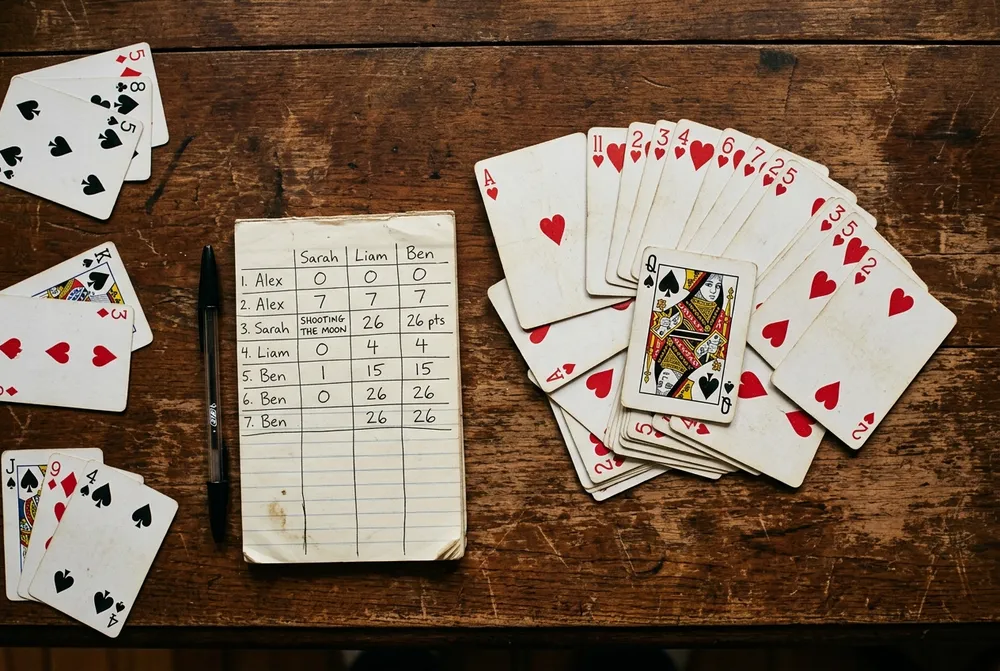
Yet the game contains a lethal paradox: if you capture every single penalty card on the table, your penalty drops to zero, and your three opponents receive twenty-six points each. This coup is called Shooting the Moon.
Mastering Hearts requires cold mathematical discipline. You need exact passing algorithms, precise suit-bleeding sequences, and the ability to detect and crush an opponent moon shot before it crosses the point of no return. You can test these tactics immediately without installation by playing Hearts on Unicorn Games directly in your browser.
Historical Origin and the Mathematics of the 26-Point Hand
Hearts traces its lineage directly to the eighteenth-century European game Reversis, where players sought to lose tricks containing penalty court cards. By the late nineteenth century, American card clubs modified Reversis into Black Lady, introducing the Queen of Spades as a catastrophic thirteen-point trap.

The card distribution and penalty points in standard Hearts form a closed, static system:
| Penalty Card | Count | Point Penalty Each | Total Value |
|---|---|---|---|
| Ace, King, Queen, Jack, 10 of Hearts | 5 cards | 1 point each | 5 points |
| 9, 8, 7, 6, 5, 4, 3, 2 of Hearts | 8 cards | 1 point each | 8 points |
| Queen of Spades (The Black Lady) | 1 card | 13 points | 13 points |
| All Diamonds and Clubs | 26 cards | 0 points | 0 points |
| Non-Penalty Spades (A, K, J through 2) | 12 cards | 0 points | 0 points |
The maximum penalty points distributed in a normal hand is twenty-six. Because the Queen of Spades alone accounts for exactly fifty percent of all available penalty points, managing the spade suit represents half of your strategic responsibility.
The Passing Cycle: Strategic Asset Elimination
Before card play begins, players exchange three cards according to a four-hand rotating sequence:
1. Hand 1: Pass three cards to the player on your left.
2. Hand 2: Pass three cards to the player on your right.
3. Hand 3: Pass three cards across the table.
4. Hand 4: Hold (no passing; play the hand as dealt).
The pass determines your hand architecture. A sloppy pass locks you into defensive traps before the opening trick is led.
Voiding: Creating Discard Escape Hatches
The most effective passing tactic is short-suit voiding. If you hold only two Diamonds (such as the 4 and 8 of Diamonds), passing both Diamonds leaves you with zero cards in that suit.
When Diamonds are led during play, you cannot follow suit. Under official rules, you may discard any card from your hand when you cannot follow suit. A created void turns every subsequent Diamond lead into a waste disposal chute where you dump dangerous high cards and Hearts onto unsuspecting trick winners.
Prioritize voiding Clubs or Diamonds over Spades. Voiding Spades when you do not hold the Queen exposes you to massive danger if opponents lead Spades, because you cannot bleed off the Queen yourself.
The Queen of Spades Passing Rule: Keep or Cut?
Novice players panic whenever they see the Queen of Spades in their opening hand. They pass her away instantly.
This is an amateur error. Passing the Queen of Spades without looking at your supporting spade suit gives an opponent control over your destiny.
Follow this decision matrix:
The Opening Trick and the Blood Rule
Play always opens with the Two of Clubs. The player holding the Two of Clubs must lead it to trick one.
All players must follow suit by playing a Club if they hold one. If a player holds zero Clubs on trick one, they may discard any card with one strict restriction:
No penalty points may be played on trick one.
You cannot discard the Queen of Spades or any Heart on the opening trick, even if you are void in Clubs. This restriction is called the Blood Rule. It prevents players from taking thirteen penalty points on the first turn through opening deal luck.
Use the opening Club trick to shed high non-penalty cards, such as the Ace of Diamonds or King of Spades, if your hand is void in Clubs.

Breaking Hearts: Legal Triggers and Suit Timing
Hearts cannot be led until the suit has been broken.
Hearts are considered broken under two conditions:
1. A player has discarded a Heart or the Queen of Spades on an off-suit trick because they could not follow suit.
2. The player whose turn it is to lead holds only Hearts remaining in their hand.
Until one of these conditions occurs, leading a Heart is illegal. Once Hearts are broken, any player winning a trick may lead Hearts at will.
If you hold a collection of low Hearts and wish to prevent an opponent from shooting the moon, breaking Hearts early forces the moon shooter to spend their high cards prematurely. Conversely, if you hold the Queen of Spades and wish to drop her safely, you must wait for an opponent to lead a suit you can slough.
Flushing the Black Lady: The Spade Hunt Protocol
The most tense phase of every Hearts match is the hunt for the Queen of Spades.
There are thirteen Spades in the deck. Master players track every spade played from the opening lead:
1. Round 1 of Spades: A low spade is led (such as the 3 of Spades). All four players must follow suit. Four spades fall. Nine spades remain in unknown hands.
2. Round 2 of Spades: A medium spade is led. Another four spades fall. Eight spades are now accounted for. Only five spades remain in play.
3. Round 3 of Spades: The danger threshold. By trick three of Spades, players who began with two or three spades are completely out. The Queen of Spades must appear, or the Ace and King holders will be cornered.
If you hold the Ace or King of Spades and know the Queen has not fallen, never lead a high Spade. Leading the Ace of Spades on round two or three invites the Queen holder to slide their Queen under your Ace. You swallow thirteen points instantly.
Lead low Spades to strip the Queen holder of their protective shields. Force them to play the Queen on an opponent trick.
Shooting the Moon: Mechanics of the 26-Point Masterstroke
Shooting the Moon occurs when one player wins all thirteen Hearts and the Queen of Spades in a single hand.
The scoring impact is catastrophic for the opposition:
Shooting the moon requires specific structural conditions in your initial deal:
1. Control of the Spade suit: You must hold the Ace, King, and Queen of Spades, or hold top honors with enough length to capture every spade trick.
2. Long, dominant side suit: You need a five-card or six-card run in Clubs or Diamonds headed by Ace and King to maintain the lead.
3. Top Heart honors: You must hold the Ace, King, and Queen of Hearts. If an opponent holds an Ace of Hearts above your King, they will capture the final trick and leave you with twenty-five penalty points.
The Point of No Return in Moon Defense
The biggest defensive mistake in Hearts is failing to recognize an opponent moon attempt until trick eight.
Watch for these early warning signs:
When you observe an opponent taking consecutive high Heart tricks and absorbing the Queen of Spades, execute the Sacrificial Defense Protocol.
In Sacrificial Defense, you must deliberately win a trick containing a single Heart, even if it adds one penalty point to your score. Taking one point breaks the moon shot completely. The shooter is saddled with twenty-five penalty points, ending their match ambitions.
Never play a low card to dodge a single point if doing so hands the trick to a suspected moon shooter. Swallowing one point to inflict twenty-five points on an enemy is the most cost-effective trade in card gaming.
Card Counting and Void Deductions
Winning consistently requires tracking four numbers in your head:
1. Spades remaining: Count down from thirteen. Identify when the Ace, King, and Queen have dropped.
2. Hearts remaining: Count down from thirteen. Keep track of how many Hearts remain in unplayed hands before leading high cards.
3. Suit voids: Note which players fail to follow suit on Clubs and Diamonds. If West throws a Heart on a Diamond lead during trick three, West holds zero Diamonds. Leading Diamonds on trick six guarantees that West will drop another penalty card.
4. High honor graveyard: Remember whether the Ace and King of each suit have been played. An eight of Clubs becomes the highest card in the deck if the 9 through Ace have already hit the felt.
Four-Step Turn Evaluation Protocol
Before placing any card on the table, process this operational checklist:
1. Moon detection: Has any single player taken every penalty card played so far? If yes, will your card allow them to take another? If they are attempting a moon shot, play your highest card to capture the trick and stop them.
2. Suit following constraints: Must you follow suit? If yes, can you play lower than the highest card already on the table? Always duck under dangerous cards unless you are hunting for control.
3. Slough selection: If you cannot follow suit, discard in this priority order: Queen of Spades first (if dangerous), highest Hearts second, high non-penalty cards (Aces and Kings) third.
4. Lead planning: If leading the next trick, never lead Spades if the Queen is unaccounted for. Lead short suits to force voids or low cards to bleed opponent honors.
Frequently Asked Questions
Yes. Shooting the moon requires capturing all fourteen penalty cards (the thirteen Hearts and the Queen of Spades). It does not require winning all thirteen tricks. An opponent can win three tricks containing only Clubs and Diamonds. As long as every penalty card lands in your scoring pile, your moon shot succeeds.

Gopal Chitaure
Verified Author & Game DeveloperGame developer and founder at Unicorn Games. Specializes in combinatorial game theory, solvability algorithms, and classic card & puzzle game development. Every guide is fact-checked against mathematical game states and empirical play benchmarks.